

Mental illness is not the cause of mass violence
As I write this the morning after the most recent school shooting, which took place in Madison, Wisconsin, I am deeply saddened by the fact that this is the 83rd mass shooting in the US in 2024. I have to wonder how much attention we will give this horrific act of violence. My fear is that it will be dismissed as “another incident caused by someone with a mental illness” and bring on more negativity toward individuals with mental health concerns.
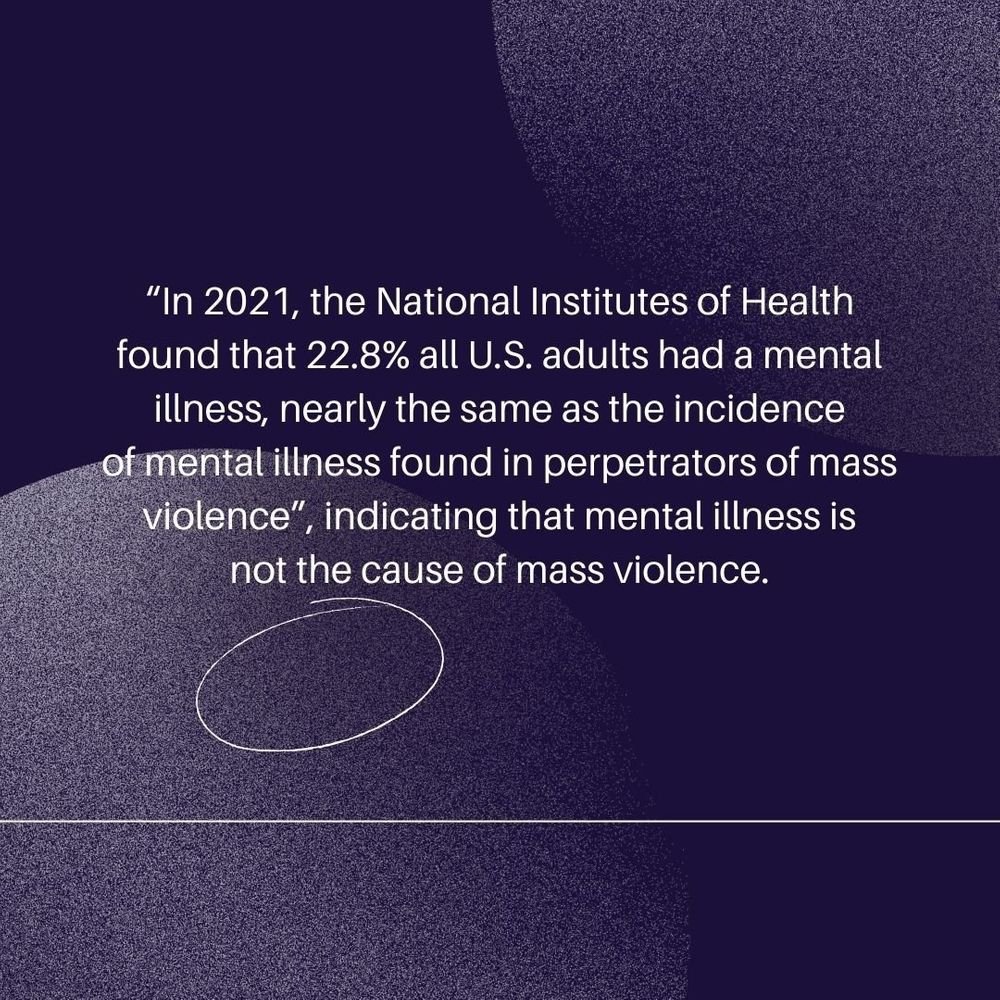
In reality, though, a report on mass violence in the US completed by the National Council on Mental Wellbeing points out that “In 2021, the National Institutes of Health found that 22.8% of all U.S. adults had a mental illness, nearly the same as the incidence of mental illness found in perpetrators of mass violence”, indicating that mental illness is not the cause of mass violence. The report goes on to say that even though there are many misunderstandings and quite a bit of speculation about the role of mental illness, it is not the primary driver of mass violence.
So, if it isn’t mental illness, then what is the cause? Many would say it is access to firearms. It is clear that people in the United States have much greater access to firearms than individuals in other high-income countries, seven times higher, to be exact. Gun homicide is 25 times higher in the US than other countries with a comparable gross domestic product. Although overall violence in the US is declining, the incidents of mass shootings are increasing. The intervals between these mass shootings are getting shorter, and injuries and deaths are increasing due to the lethality of gun usage. So, in answer to the question, guns aren’t the cause of violence, but they do cause a significant increase in injuries and deaths. A ban on assault rifles wouldn’t likely change the rate of mass shootings, but it would reduce the number of fatalities during such an event.
Studies of perpetrators of mass violence have identified commonalities among most of them. Many seek personal notoriety and/or attention for a group or cause. Many are suicidal or indifferent to life. Many of them feel victimized by individuals or groups in our society. Many believed they had reached a crisis point at work or in their relationships that drove them to lash out. Attacks are often premeditated and planned. Joe Parks, Medical Director for the National Council for Mental Wellbeing has stated, “What’s happening in our society is not a mental illness; it’s a social illness. Hate and anger are not mental illnesses.” We are at a crisis point of intolerance and hatred toward each other, especially of those who don’t look, act, or believe the way we do. Many of us can admit that our social media feeds have been filled with bullying and anger, especially during the elections. Around the country, law enforcement has reported that from
2020-2022, hate crimes went up 11.6%.
We cannot sit back and allow hatred and intolerance to fester and grow. There is no single cause of mass violence; however, we do know that when members of our community feel isolated and hated, it increases their distrust towards others, decreases community engagement, and increases the risk of violence. It is up to all of us to create a true sense of community that provides everyone with a sense of belonging, support, and identity. Our goal should be to help our fellow community members to feel less alone and stressed. It takes all of us to step forward and help our community address the pressing issues of our time. In the words of the great Dr. Martin Luther King, Jr, “We will have to repent in this generation not merely for the hateful words and actions of the bad people but for the appalling silence of the good people. Human progress never rolls in on wheels of inevitability; it comes through the tireless efforts of men willing to be co-workers with God, and without this hard work, time itself becomes an ally of the forces of social stagnation. We must use time creatively, in the knowledge that the time is always ripe to do right.” I hope we all make it our new year’s resolution to be more engaged, tolerant, and supportive of those in our community who need us the most.
Read the full report: Mass Violence in the United States: Definition, Prevalence, Causes, Impacts and Solutions